SERVICING HUNTER REGION, NEWCASTLE, CENTRAL COAST, CANBERRA
Full bulk waste removal and property cleanouts across Newcastle and the Hunter Region — handled methodically, with discretion when it matters.
First job is going through everything systematically — what’s salvageable, what isn’t, and what needs specialist treatment beyond our scope. We give you an honest assessment with photos and inventories for both categories, which is what you need for insurance either way. If we think something’s not worth restoring, we’ll tell you up front — better than spending your money on something that won’t come back the way you’d want.
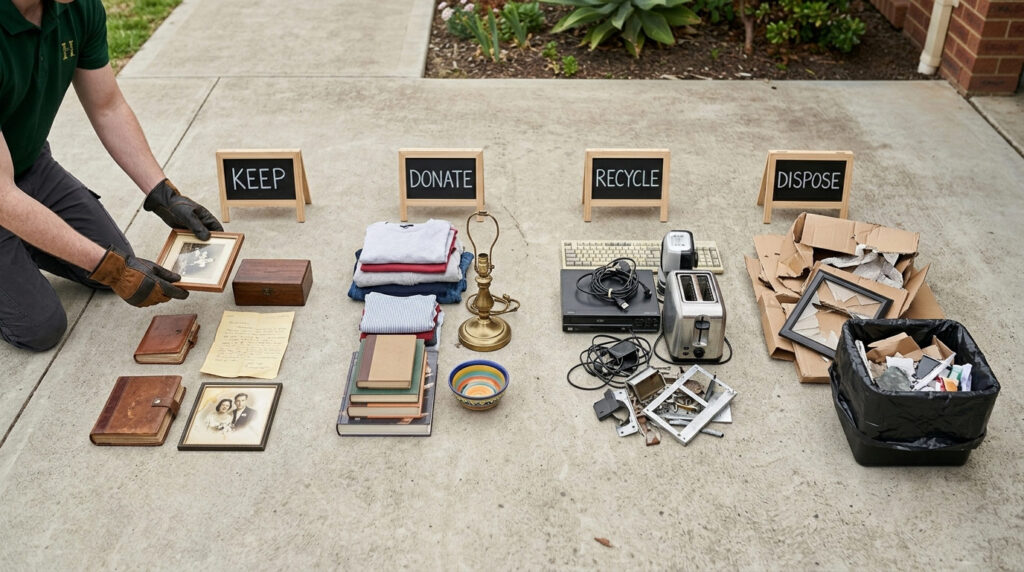
This is often where we earn our keep. We work through the property methodically — separating items into salvage, recycle, donate, and dispose categories. We document anything significant we find — personal effects, important documents, valuables — and set them aside for you. The goal is to make sure nothing that matters gets thrown away.
The heavy lifting and proper disposal. We use the right equipment and the right disposal pathways for each category — including licensed disposal for hazardous materials, certified recyclers for e-waste, and donation pathways for usable furniture and goods. Everything’s documented if you need it for an estate, an insurance claim, or your own records.
Once the property’s cleared, we leave it ready for whatever comes next — sale, restoration, or new tenants. This usually includes a sweep-out clean (removing dust, debris, and surface dirt) so the property is presentable on handover. For more involved jobs, we coordinate with our specialist cleaning service for a deeper finish.
Most bulk waste removal is straightforward — heavy stuff needs to go, it goes. Skip bin, truck, hauled away, done. That’s a legitimate service, and plenty of operators do it well.
What we do is different in two specific ways. The first is sorting. Particularly for deceased estates, hoarder situations, and major cleanouts, the difference between rushing the job and doing it properly is whether the things that matter get found before they get thrown out. Photographs in a drawer. Documents in a folder. A signed book on a shelf. The will in an envelope under a stack of magazines. We work through properties methodically because that’s the only way to make sure what should stay does.
The second is respect for the situation. Hoarder properties, deceased estates, even routine major cleanouts can be emotionally loaded — for the family, for the executor, for the person who lives there. We work quietly, discreetly, and without judgment. We don’t make the situation harder than it already is.
That work takes longer than a haul-and-dump approach. It also produces a different outcome — one where the property is properly cleared, the things that mattered are preserved, and the people involved feel respected through the process. That’s the work we do.
Pricing depends on volume, complexity, and what’s involved — a straightforward end-of-tenancy cleanout is very different from a deceased estate or a hoarder property. We give you a clear quote after the on-site assessment so you know exactly what you’re paying. For larger or staged jobs, we can break the quote into phases.
For a typical residential cleanout, anywhere from one to five days depending on volume and the sorting required. Larger or more sensitive jobs — significant hoarder situations, large deceased estates, jobs involving hazardous materials — can run longer. We give you a realistic timeframe up front, not an optimistic one.
Yes — we handle hoarder situations of any scale, including ones involving significant volume, biohazard risk, or sensitive personal circumstances. Our approach is the same as for any cleanout: methodical, respectful, and discreet. We don’t sensationalise the situation, we don’t pass judgment, and we work to make the process as straightforward as possible for whoever’s coordinating the job.
We handle these properly. Asbestos requires licensed assessment and removal — we coordinate with a licensed removalist where it’s involved. Biohazards get handled in PPE and disposed of through licensed pathways. Chemical waste goes through certified disposal services. We don’t take shortcuts on this, and we document everything for your records.
What happens to items? Items get sorted into four categories: salvage (kept for the family or estate), donate (to a charity partner if usable), recycle (e-waste, scrap metal, recyclables), and dispose (everything else, through proper waste pathways). We document the sorting where it matters — particularly for estates where the executor needs records of what was preserved vs disposed.
Yes. We provide itemised records of what’s been preserved (set aside for family or executor), what’s been donated, what’s been disposed of, and any items of potential value we’ve flagged for review. This documentation supports probate, estate administration, and any insurance or tax requirements that might apply.
Of course — either approach works. Some families prefer to be there for the sort phase, particularly for deceased estates, so they can make decisions on items as we go. Others find it easier to give us guidance up front and let us work through it. Both are fine. We’ll work to whatever suits the situation.
We handle cleanouts across Newcastle, Maitland, Lake Macquarie, the Hunter Valley, and Port Stephens. Larger jobs outside these areas are possible — travel time and logistics will be quoted upfront.
Tell us what you’re dealing with — even if it’s complicated. We’ve worked across the full range, and we’ll talk you through the process honestly before any commitment. Free assessments, no pressure, full discretion.